
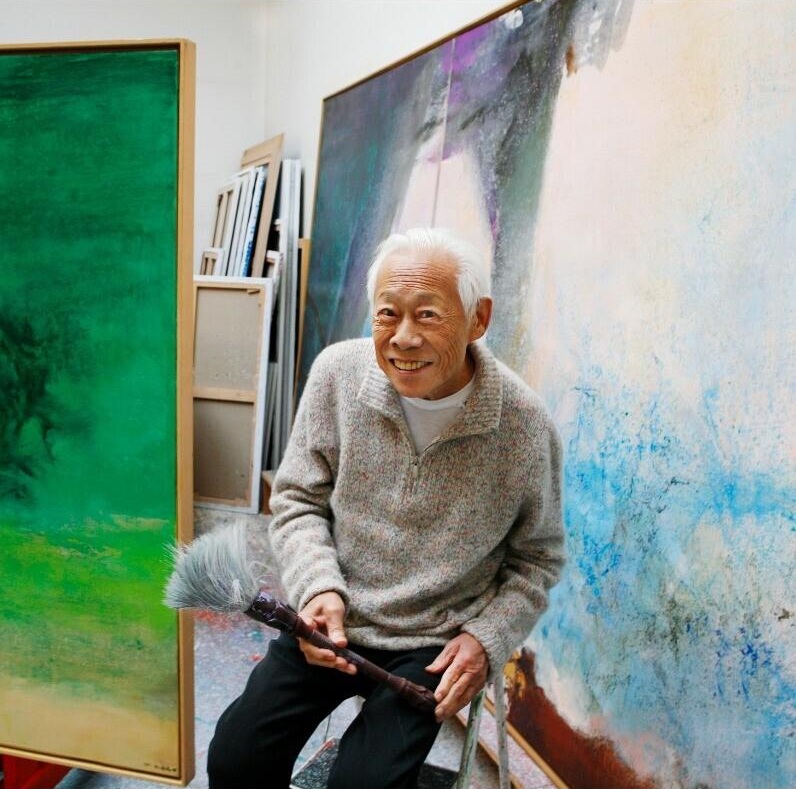
Zao Wou-Ki (1920–2013, Beijing, China) was a major figure of post-war abstraction whose work created a remarkable dialogue between Chinese artistic traditions and Western modernism. Combining the spatial sensitivity and calligraphic energy of Chinese painting with the freedom of European lyrical abstraction, he developed a highly personal visual language of atmospheric colour, movement and light.
Raised in an educated family with a strong appreciation for Chinese art, Zao studied at the China Academy of Art in Hangzhou, where he received both traditional Chinese and Western academic training. Initially fascinated by European modernism—particularly Cézanne, Matisse and Picasso—he moved to Paris in 1948 and quickly became part of the city's international artistic community.
During the 1950s, Zao progressively abandoned figurative imagery. An encounter with the work of Paul Klee proved especially important, encouraging him to explore signs and symbols reminiscent of ancient Chinese oracle-bone inscriptions. These elements gradually dissolved into increasingly abstract compositions in which sweeping gestures, shifting planes of colour and luminous spaces suggest landscapes without explicitly depicting them.
From the late 1950s onward, Zao developed the powerful abstract paintings for which he is best known. Working in oil on increasingly large canvases, he combined energetic brushwork with extraordinary areas of atmospheric depth. Although created within the context of European abstraction, these paintings also reveal the enduring influence of Chinese landscape painting, particularly its conception of space, emptiness and the movement of natural forces.
Alongside his oils, Zao maintained an important practice in watercolour, ink, lithography and printmaking. His return to Chinese ink became particularly significant during the later decades of his career, allowing him to reconnect more directly with the artistic tradition he had deliberately distanced himself from as a young painter. Rather than separating Eastern and Western traditions, his mature work increasingly allowed them to coexist.
Zao became a French citizen in 1964 and achieved substantial international recognition during his lifetime, with exhibitions and retrospectives across Europe, Asia and the United States. His friendship with artists and intellectuals including Pierre Soulages, Hans Hartung, Alberto Giacometti and Henri Michaux placed him at the heart of post-war Parisian artistic life.
Today, Zao Wou-Ki is recognized as one of the defining artists to bridge Asian and European modernism. His synthesis of calligraphic gesture, atmospheric space and Western abstraction created an unmistakable body of work, while his paintings and works on paper occupy an increasingly prominent position in major museum collections and the international art market.