

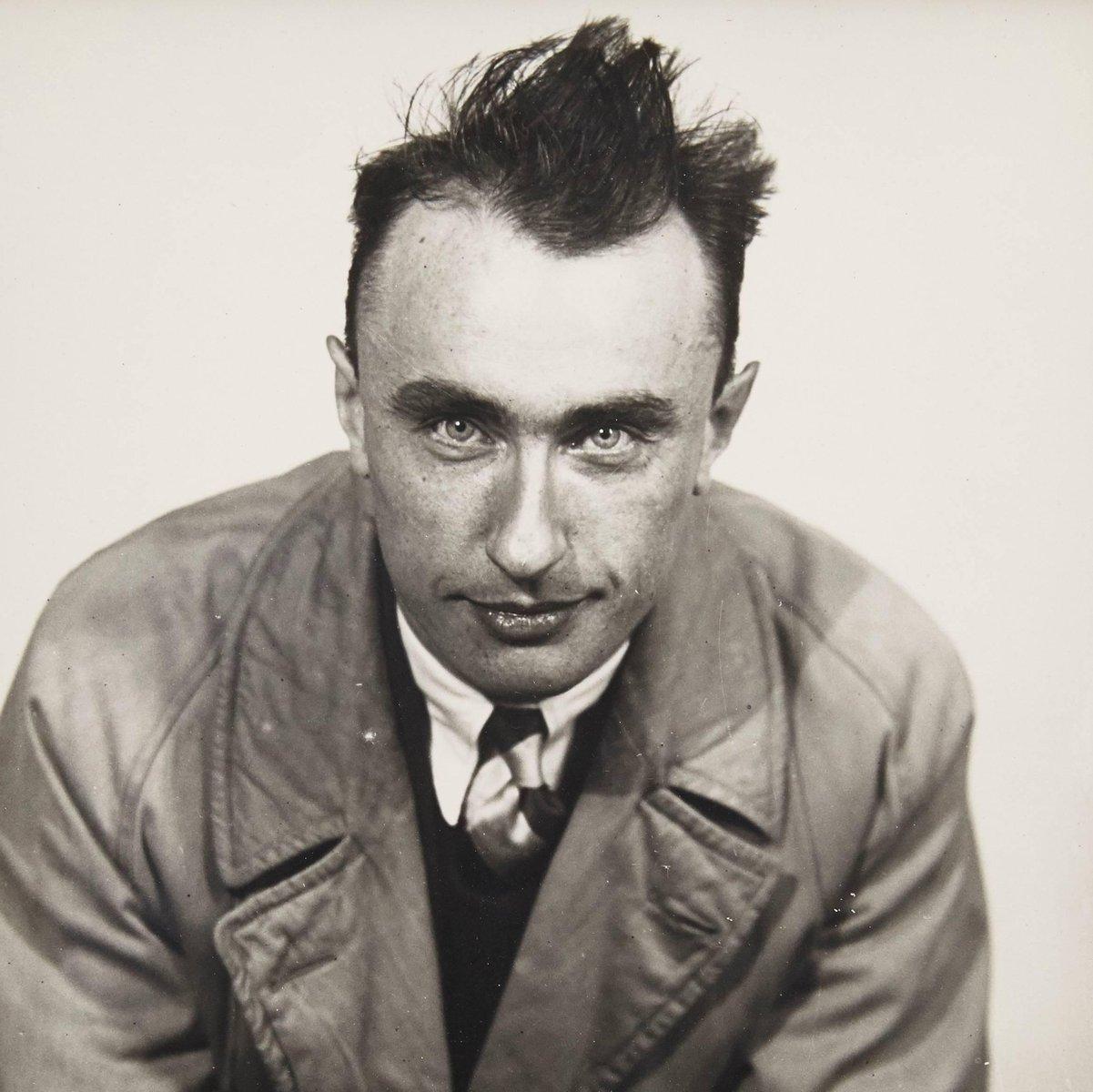
Yves Tanguy (1900–1955, Paris, France) was one of the most distinctive painters associated with Surrealism, known for strange, dreamlike landscapes populated by biomorphic forms that seem to exist outside ordinary time and space. His meticulously rendered worlds combine vast horizons, mysterious objects and an almost geological sense of stillness, creating a visual language that became instantly recognizable.
Largely self-taught, Tanguy began painting seriously during the 1920s after encountering the work of Giorgio de Chirico. He joined the Surrealist group in 1925 and quickly became closely associated with André Breton and other leading figures of the movement. Unlike artists who relied primarily on automatic drawing, Tanguy developed his compositions through painstakingly controlled painting, giving his imaginary forms an eerie sense of physical reality.
His paintings typically present barren, seemingly infinite landscapes filled with smooth, ambiguous objects resembling stones, bones, organisms or fragments of unknown machinery. Shadows and carefully modulated light give these forms a remarkable sense of volume, while the absence of recognizable scale or narrative transforms the scenes into psychological rather than literal spaces.
In 1939, Tanguy moved to the United States with the American painter Kay Sage, whom he later married, and eventually settled in Connecticut. His later paintings became increasingly complex and densely populated, while retaining the dreamlike atmosphere and extraordinary technical precision that characterized his earlier work. The Museum of Modern Art in New York organized a major retrospective of his work in 1955, the year of his death.
Today, Yves Tanguy is regarded as a central figure of Surrealist painting. His enigmatic landscapes and precisely rendered imaginary forms profoundly influenced later generations of artists and remain among the most compelling visual explorations of the unconscious within twentieth-century art.