
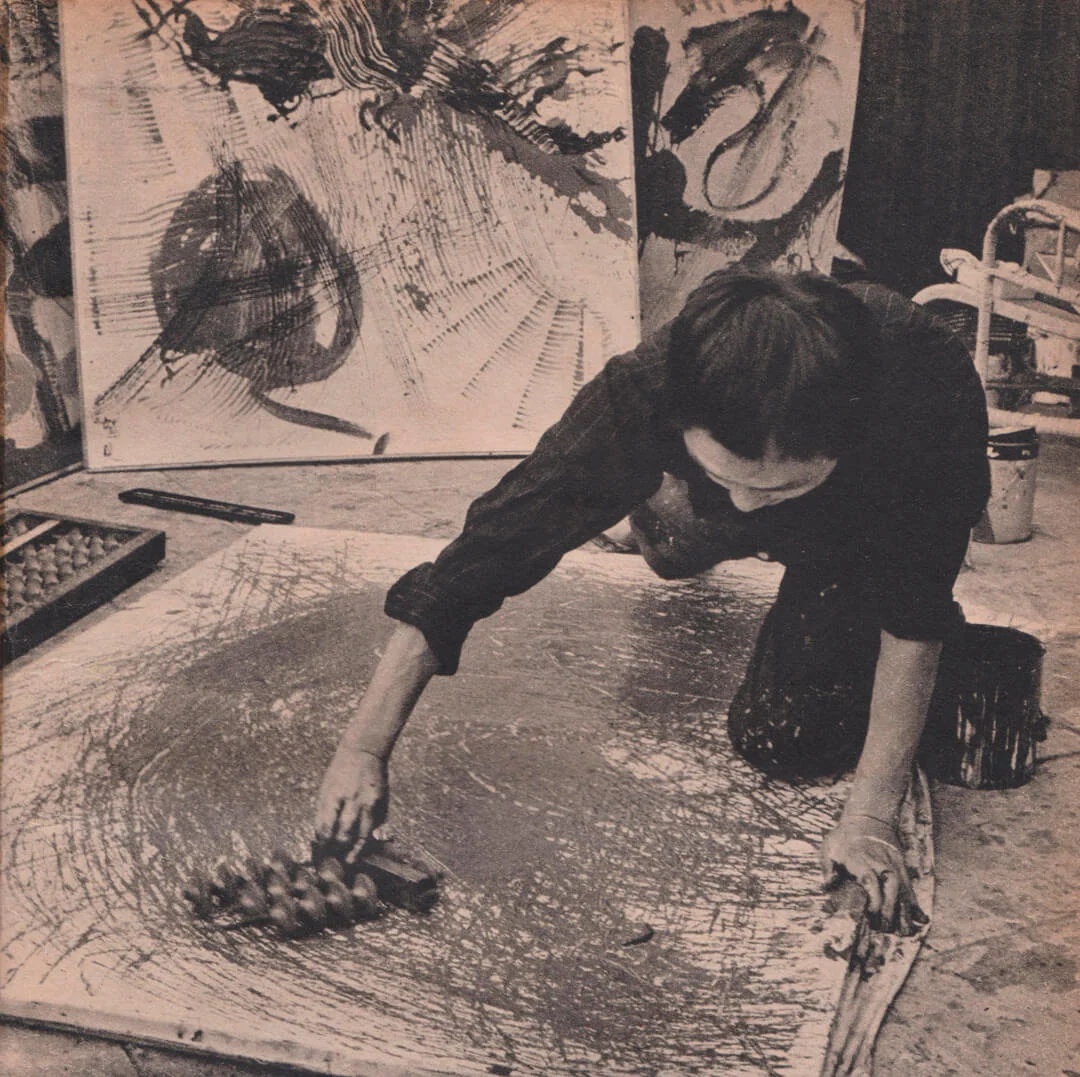
Yasuo Sumi (1925–2015, Osaka, Japan) was a key figure of the Gutai Art Association, known for an experimental approach to painting that replaced conventional brushes with everyday objects and mechanical tools. His works combine gesture, repetition and chance, transforming simple devices such as abacuses, umbrellas and vibrating mechanisms into instruments for creating highly distinctive abstract surfaces.
Sumi began painting while working as a teacher and had no formal artistic training. Encouraged by Shozo Shimamoto, he entered the emerging Gutai circle in the mid-1950s and joined the association in 1955. He subsequently participated in Gutai exhibitions throughout the movement’s active years, embracing its call for artistic freedom and direct engagement with materials.
One of Sumi’s most characteristic techniques involved rolling a paint-covered soroban, the traditional Japanese abacus, across paper or canvas. The repeated marks produced by the beads created rhythmic patterns that combined mechanical structure with unpredictable movement. He also experimented with traditional umbrellas, wire mesh and other unconventional tools, continually challenging the distinction between artistic material and ordinary object.
After the dissolution of Gutai, Sumi continued to work and exhibit, maintaining the experimental principles that had shaped his early practice. His work has been presented internationally, including exhibitions at the Guggenheim Museum in New York, the Jeu de Paume in Paris and museums across Japan and Europe, and is held in several major institutional collections.
Today, Yasuo Sumi is recognized as one of Gutai’s most distinctive voices. His inventive use of ordinary tools, combined with an enduring commitment to spontaneity and material experimentation, gave his work a unique place within the history of post-war Japanese abstraction.