

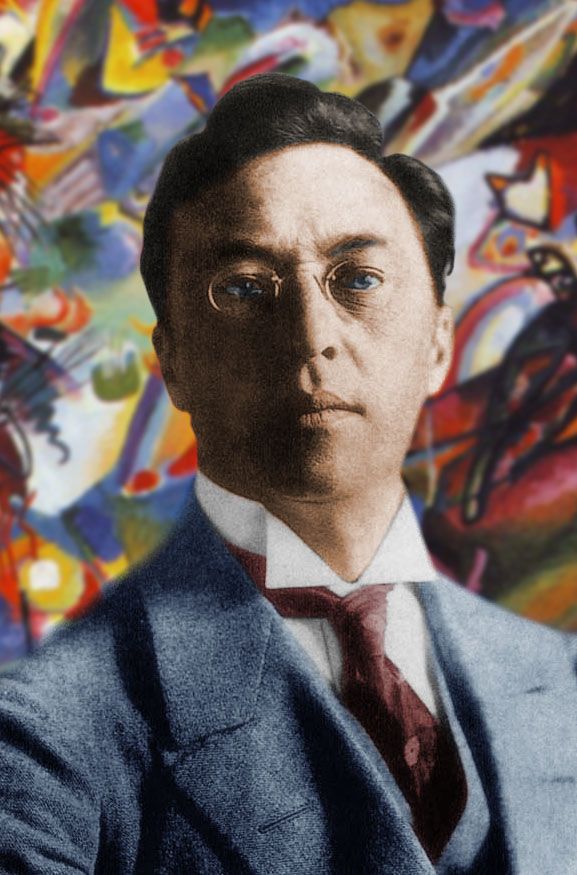
Wassily Kandinsky (1866–1944, Moscow, Russia) was a pioneering force in the development of abstract art, transforming colour, line and form into an independent visual language. Deeply interested in the relationship between painting, music and spirituality, he believed that art could communicate directly through colour and composition without relying on recognizable subjects.
Originally trained in law and economics, Kandinsky abandoned his academic career at the age of thirty and moved to Munich to study art. There he became a central figure of the European avant-garde and, together with Franz Marc, co-founded Der Blaue Reiter in 1911. His influential writings, particularly On the Spiritual in Art, helped establish the theoretical foundations of abstraction and explored the psychological and emotional power of colour and form.
After returning to Russia during the First World War, Kandinsky moved back to Germany in the early 1920s and joined the Bauhaus, where he taught from 1922 until the school was closed under pressure from the Nazi regime in 1933. During these years his work became increasingly geometric, combining circles, triangles, lines and overlapping planes in carefully balanced compositions. He subsequently settled in Neuilly-sur-Seine near Paris, where his late work developed a softer, more organic and biomorphic vocabulary.
Kandinsky's radical exploration of abstraction fundamentally changed the course of modern art. His works are represented in major museum collections worldwide, with the Guggenheim Museum alone holding more than 150 works, reflecting the exceptional importance of his legacy within twentieth-century art.