

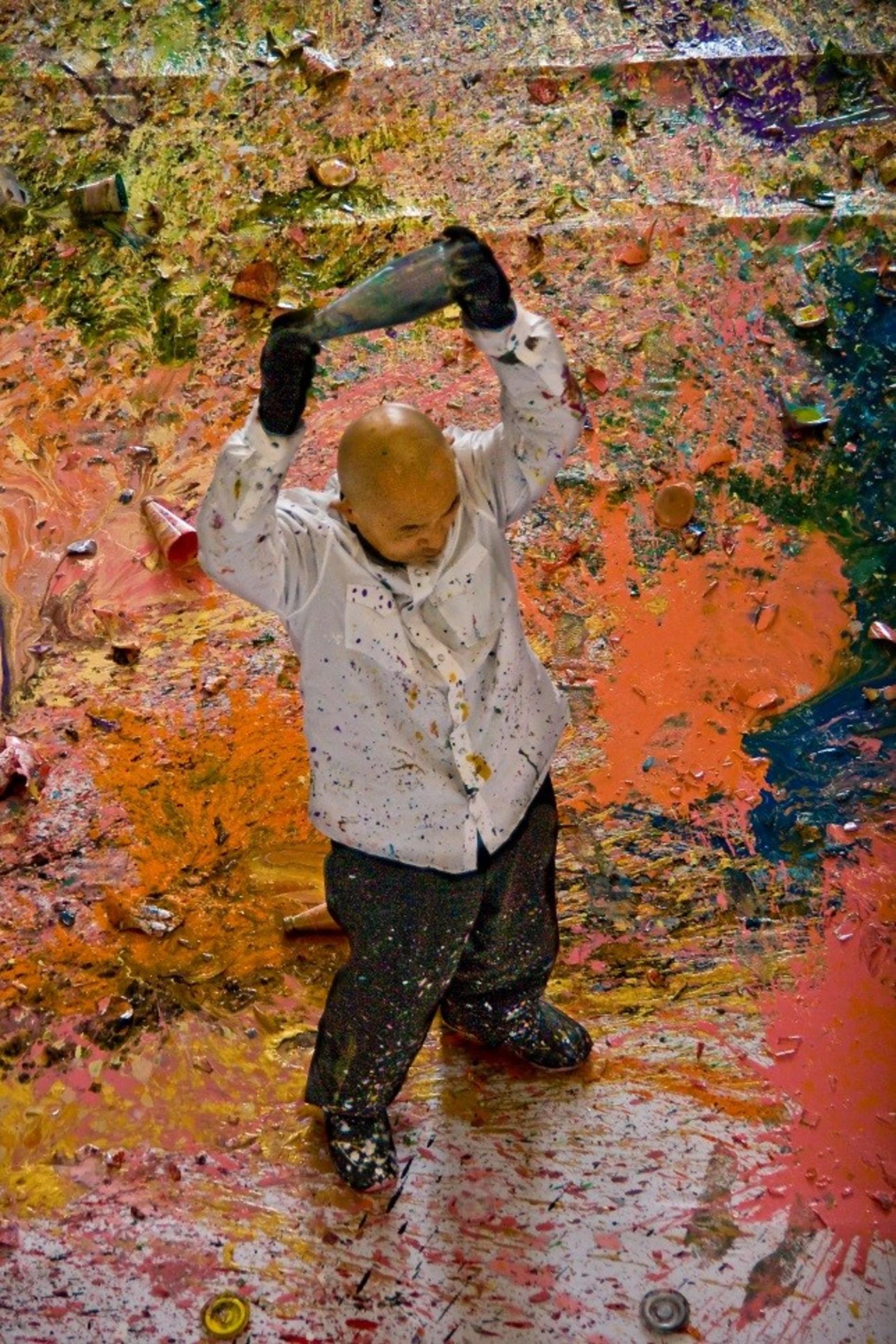
Shozo Shimamoto (1928–2013, Osaka, Japan) was a pioneering figure of the Gutai Art Association and one of the most radical experimental artists of post-war Japan. His work transformed painting into an event, emphasizing physical action, chance and the direct interaction between artist, material and space.
Shimamoto co-founded Gutai in 1954 together with Jiro Yoshihara and became one of the movement’s most innovative members. Rejecting conventional brushwork, he explored unconventional techniques that allowed paint to behave freely. In some of his best-known works, he hurled glass bottles filled with pigment onto large canvases, allowing the impact, splashes and fragments to determine the final composition.
This emphasis on action and material process placed Shimamoto at the forefront of international developments that paralleled Action Painting, Happenings and later performance art. For him, the artwork was not simply the finished surface but also the act of creation itself—the sound, movement, risk and unpredictability of the performance.
Throughout his career, Shimamoto continued to experiment with painting, sound, mail art and performance. His large-scale bottle-throwing actions were staged internationally, often before live audiences, reinforcing the idea that painting could become a public and collective experience rather than a private studio activity.
Today, Shozo Shimamoto is recognized as one of the defining figures of Gutai and an important precursor of performance-based contemporary art. His radical fusion of painting and action helped expand the boundaries of artistic practice and remains a crucial contribution to the history of the post-war avant-garde.