

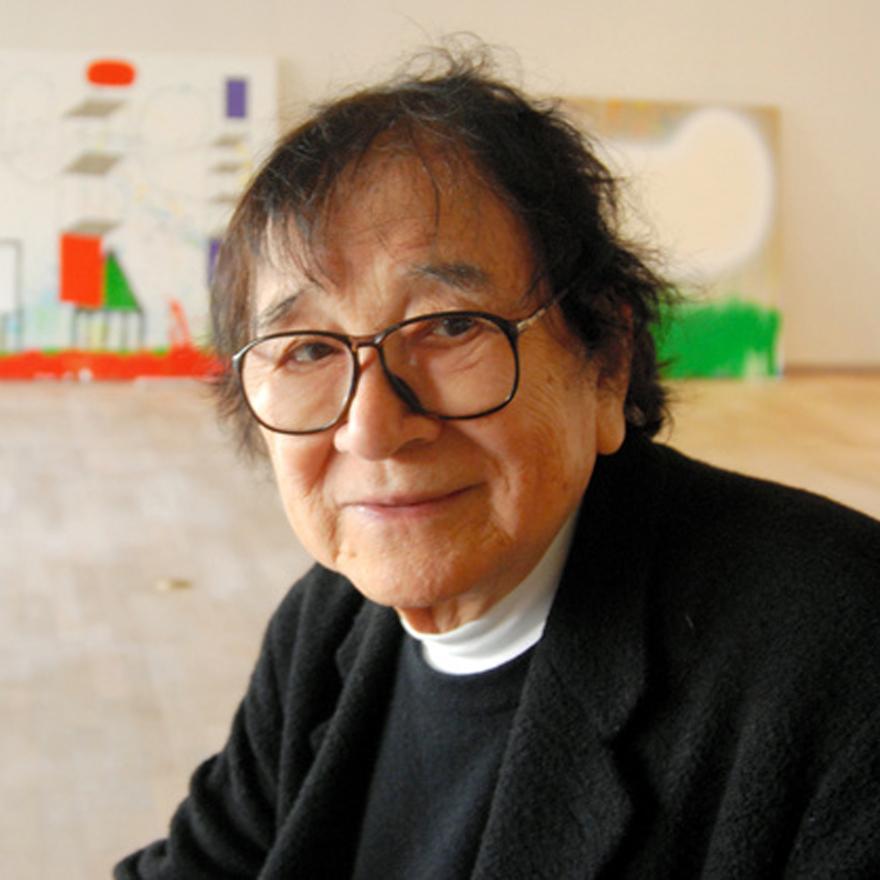
Sadamasa Motonaga (1922–2011, Iga, Mie Prefecture, Japan) was a leading figure of the Gutai Art Association and one of the most inventive artists of post-war Japanese abstraction. Known for his playful use of colour, fluid forms and experimental materials, Motonaga developed a visual language that combined spontaneity, humour and a deep fascination with the physical behaviour of paint and other materials.
Largely self-taught, Motonaga joined Gutai in 1955 and remained an active member until 1971. In his early Gutai works, he experimented with inexpensive and unconventional materials, creating suspended “water sculptures” from vinyl tubes filled with coloured liquid and paintings in which enamel paint was poured and allowed to flow across the surface. His approach reflected Gutai’s broader ambition to allow materials to reveal their own expressive qualities rather than simply serve traditional representation.
A stay in New York in 1966–67 introduced Motonaga to new techniques and helped transform his practice. After returning to Japan, he increasingly used airbrush and acrylic paint to create smooth, vividly coloured forms with soft gradients, often floating against monochrome backgrounds. These later works retained the experimental spirit of Gutai while becoming more graphic, humorous and immediately recognizable.
Motonaga also worked extensively in sculpture, printmaking and children’s books, bringing the same sense of playfulness and visual invention to each medium. His work has been included in major international exhibitions devoted to Gutai, including the Guggenheim Museum’s landmark Gutai: Splendid Playground, helping to establish his importance within the broader history of post-war abstraction.
Today, Sadamasa Motonaga is recognized as one of the defining artists of Gutai. His combination of material experimentation, brilliant colour and irreverent humour gave his work an unusually joyful character and secured his place among the most distinctive voices of the Japanese post-war avant-garde.