
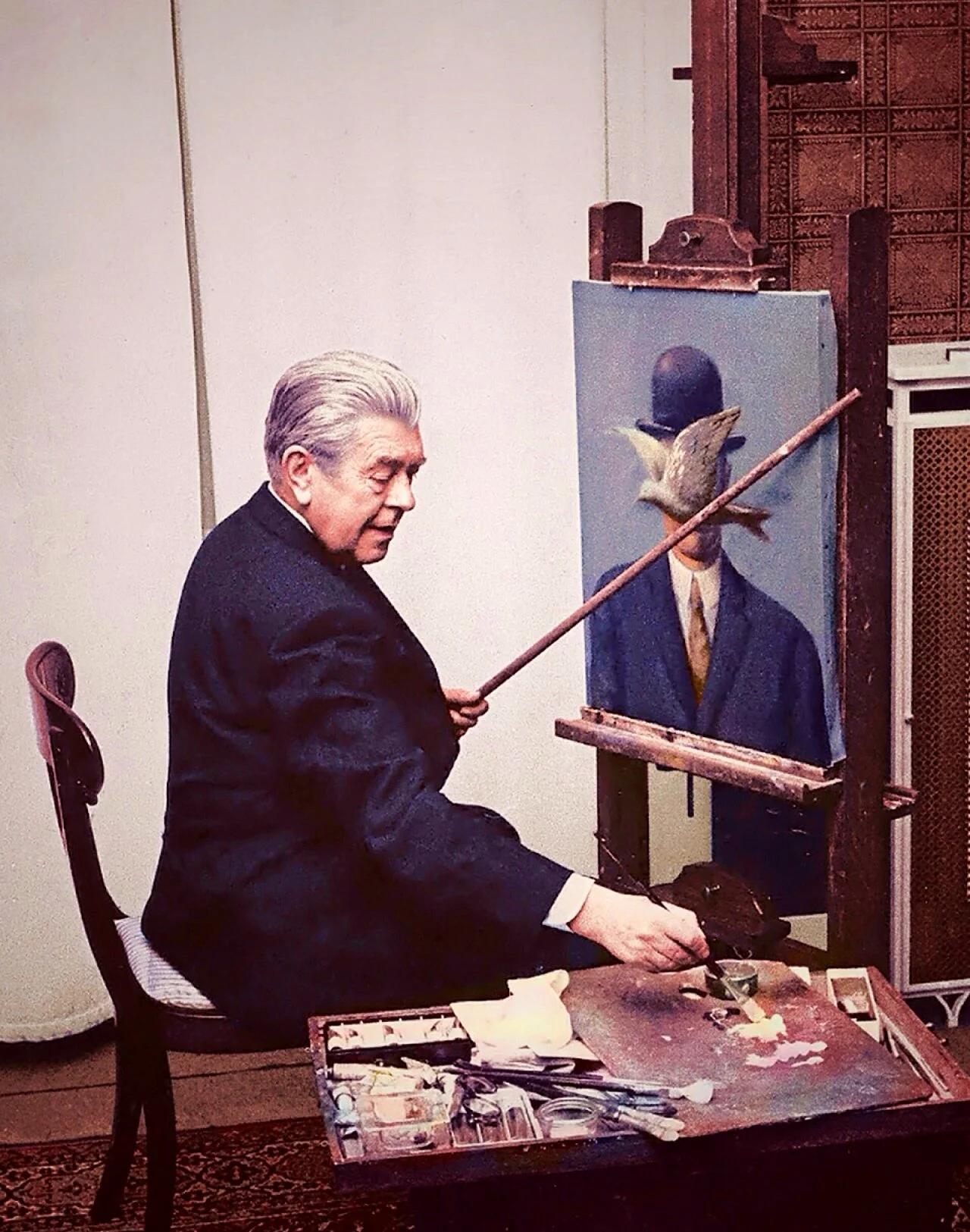
René Magritte (1898–1967, Lessines, Belgium) transformed ordinary objects into enigmatic images that challenge the relationship between reality, language and representation. With his precisely painted bowler hats, floating apples, cloudy skies, concealed faces and impossible interiors, he developed one of the most distinctive visual languages of Surrealism.
After studying at the Académie Royale des Beaux-Arts in Brussels, Magritte initially worked as a commercial artist and designer. During the 1920s, his encounter with the work of Giorgio de Chirico proved decisive, encouraging him to explore the mysterious possibilities of familiar objects placed in unexpected contexts. He became a leading figure of Belgian Surrealism alongside artists and writers including Paul Nougé and Louis Scutenaire.
Unlike the dreamlike automatism associated with some Surrealists, Magritte approached painting with deliberate clarity. Everyday objects are rendered in an almost impersonal style while their scale, location or relationship to one another is subtly disrupted. Works such as The Treachery of Images, with its famous declaration “Ceci n'est pas une pipe”, question the distinction between an object, its image and the words used to describe it.
Recurring motifs—including the bowler-hatted man, birds, windows, curtains, apples and skies—allowed Magritte to repeatedly investigate perception and illusion. Behind the apparent simplicity of his compositions lies a philosophical concern with how images shape our understanding of reality, an approach that would later exert a profound influence on Pop Art and Conceptual Art.
Today, René Magritte is regarded as a defining figure of twentieth-century art and one of Belgium's most internationally celebrated artists. His ability to make the familiar strange through deceptively simple images has given his work an enduring cultural influence extending far beyond Surrealism.