

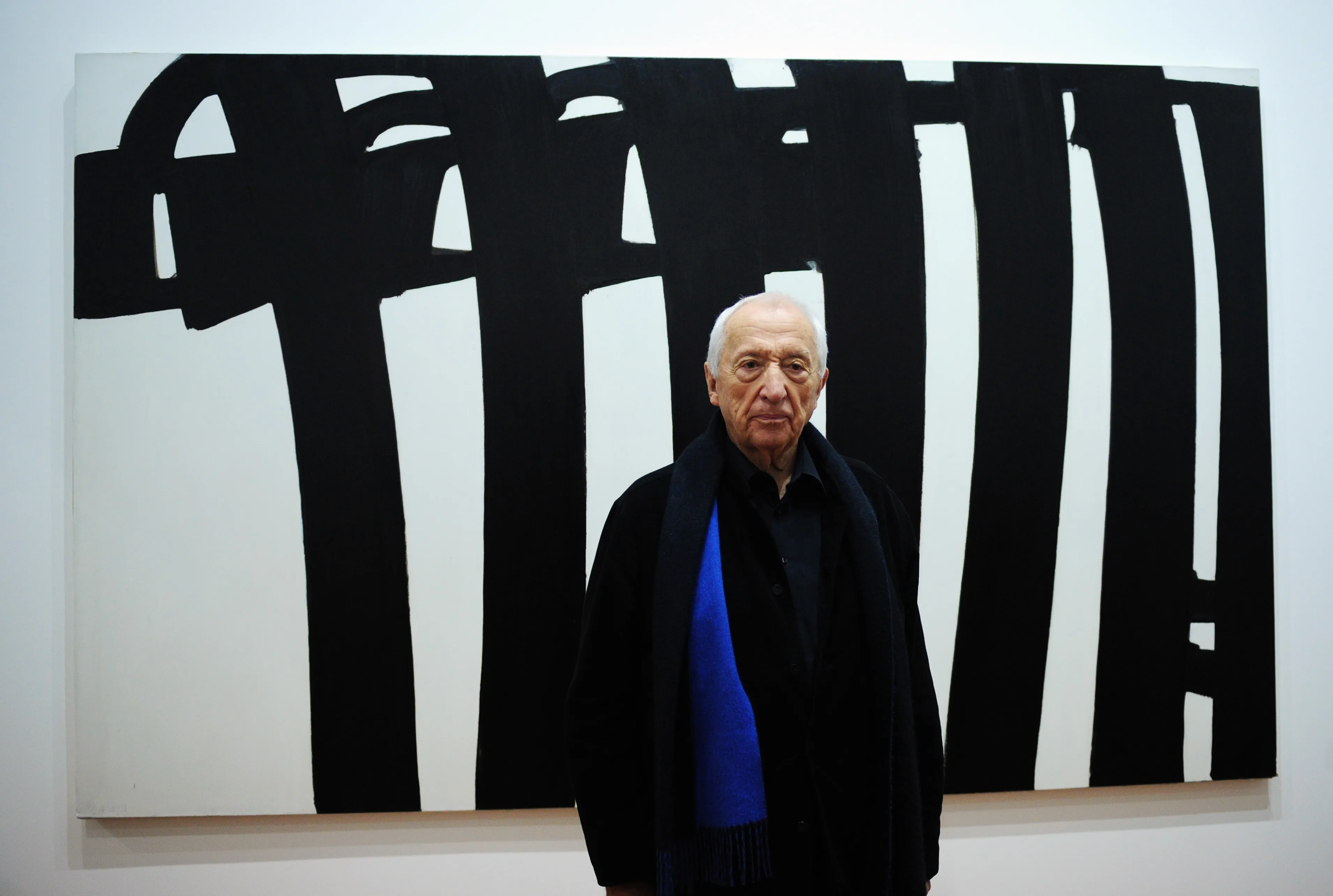
Pierre Soulages (1919–2022, Rodez, France) was one of the most important figures of post-war European abstraction, renowned for a lifelong exploration of black, light and the physical surface of painting. Often described as the “painter of black and light,” Soulages developed a radically reduced visual language in which darkness became a source of luminosity rather than absence.
From the late 1940s onward, Soulages gained recognition for paintings built from broad, forceful bands of dark pigment applied with brushes, scrapers and improvised tools. Rejecting representation, he focused on rhythm, texture and the interaction between painted surface and surrounding light. His early use of walnut stain on paper already revealed an interest in dense, abstract structures and the expressive possibilities of a restricted palette.
A decisive development came in 1979, when Soulages began creating works he described as Outrenoir—literally “beyond black.” In these paintings, thick black surfaces are scored, scraped or polished so that light is reflected differently across ridges, grooves and smooth areas. The result is a constantly changing experience in which the apparent darkness of the painting is transformed by the viewer’s position and the surrounding light.
Soulages exhibited internationally throughout a career spanning more than seven decades. Major retrospectives were organized by institutions including the Centre Pompidou, while the Musée Soulages in Rodez is devoted to his work and holds an extensive collection representing the breadth of his practice.
Today, Pierre Soulages is regarded as a defining master of post-war abstraction. His sustained investigation of black as a material, spatial and luminous phenomenon created one of the most distinctive bodies of work in modern European painting and secured his place among the major artists of the twentieth and early twenty-first centuries.