

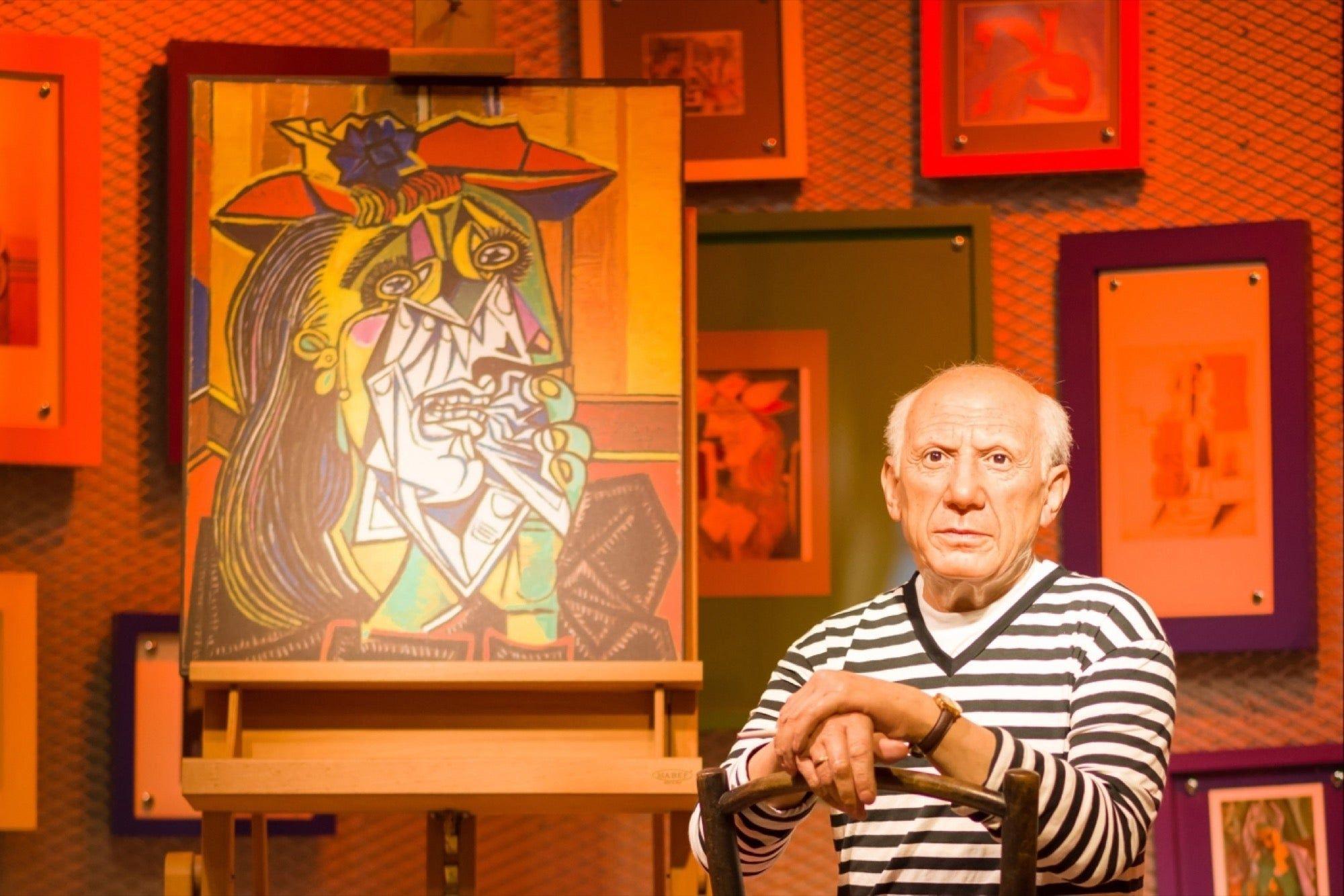
Pablo Picasso (1881–1973, Málaga, Spain) changed the course of modern art more than almost any other artist of the twentieth century. But behind his extraordinary creativity stood a passionate, restless and deeply contradictory man whose personal experiences continually transformed his art.
His story began with an extraordinary talent.
Born into the family of an art teacher, Picasso demonstrated exceptional drawing skills from childhood. As a young man, he moved between Spain and Paris, determined to become an artist. But in 1901, tragedy struck when his close friend Carlos Casagemas died by suicide.
The loss deeply affected Picasso.
His paintings became dominated by melancholy blues, depicting beggars, lonely figures and society's forgotten people. This became his celebrated Blue Period, when personal grief and human suffering found expression through colour.
But Picasso never remained the same artist for long.
His subsequent Rose Period introduced warmer colours and circus performers. Then, in 1907, he painted Les Demoiselles d'Avignon, a revolutionary composition that challenged centuries of artistic tradition. Together with Georges Braque, he went on to develop Cubism, breaking objects and human figures into multiple perspectives.
He was no longer simply painting what the eye could see. He was reinventing how reality could be represented.
Yet his life was as turbulent as his artistic transformations.
Women played a central role in Picasso's world. His relationships with Fernande Olivier, Olga Khokhlova, Marie-Thérèse Walter, Dora Maar, Françoise Gilot and Jacqueline Roque profoundly influenced his art. Their faces and bodies appeared repeatedly in his paintings, often transformed beyond recognition.
But these relationships were not always romantic stories. Picasso's infidelity, possessiveness and unequal relationships with women have become an important part of the critical reassessment of his legacy. Françoise Gilot, herself an accomplished painter, eventually left him and later published a revealing account of their life together.
Picasso could create images of extraordinary tenderness while causing considerable pain to those closest to him.
Then came the Spanish Civil War.
In 1937, horrified by the bombing of the Basque town of Guernica, Picasso created one of the most powerful anti-war paintings in history. Its distorted figures, screaming women and suffering animals transformed the destruction of a single town into a universal image of human tragedy.
Picasso opposed Franco's dictatorship and refused to allow Guernica to return to Spain until democratic freedoms had been restored. He remained in France throughout the Second World War, continuing to work under German occupation.
Even in old age, his creativity seemed almost unstoppable.
In 1968, at the age of 86, Picasso produced his extraordinary Suite 347: a series of 347 original etchings completed in less than seven months. Filled with artists, lovers, musketeers and scenes of desire, the series reads almost like an intimate theatrical reflection on his own life, imagination and artistic obsessions.
Picasso died in Mougins, France, in 1973, aged 91, leaving behind an immense body of paintings, drawings, sculptures, ceramics and original prints.
Picasso's genius lay not only in his ability to reinvent art, but in his relentless need to reinvent himself. His work reveals the extraordinary beauty of human creativity — alongside its contradictions, passions and darker impulses. To understand Picasso's art is also to confront the complexity of the man who created it.