
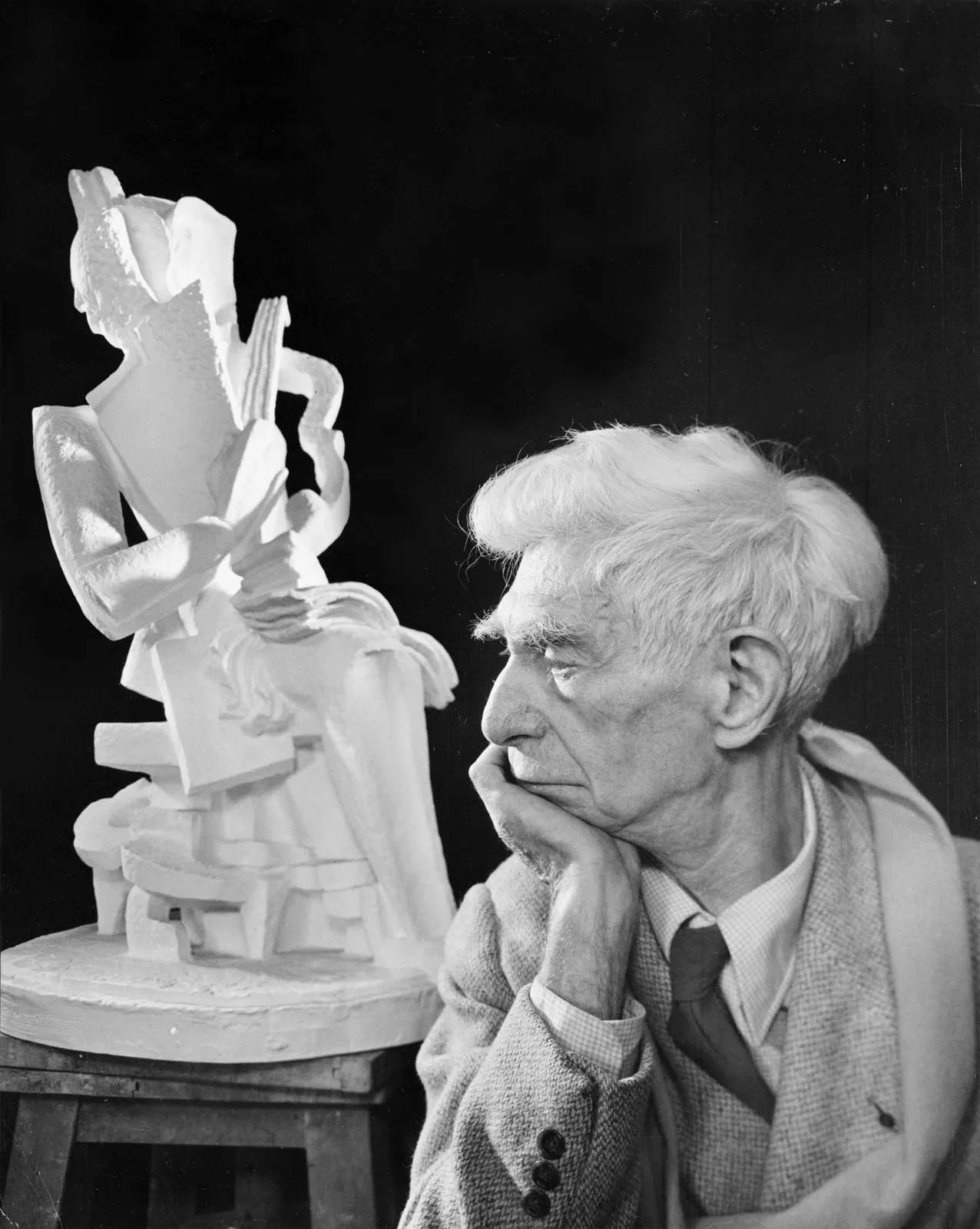
Ossip Zadkine (1890–1967, Vitebsk, present-day Belarus) was a major figure of twentieth-century modernism and one of the most distinctive artists associated with the École de Paris. Best known as a sculptor, he also produced an extensive body of drawings, gouaches, watercolours, paintings and prints. Across these different media, Zadkine developed an expressive visual language in which the human figure was fragmented, elongated and reconstructed through a highly personal interpretation of Cubism.
Born in Vitebsk, then part of the Russian Empire, Zadkine spent several formative years in England before settling in Paris in 1910. He briefly attended the École des Beaux-Arts but quickly rejected academic training in favour of experimentation and a more direct relationship with materials. Encounters with Cubism and with African, Egyptian and ancient sculpture profoundly influenced his development, although he resisted becoming identified with any single movement.
During the 1910s and 1920s, Zadkine increasingly transformed the human body into angular arrangements of concave and convex forms. Musicians, lovers and figures drawn from mythology became recurring subjects throughout his career. Music was particularly important to his imagination, appearing repeatedly in sculptures as well as in drawings, gouaches and graphic works.
Alongside sculpture, Zadkine maintained an extensive practice as a draughtsman, painter and printmaker. He produced numerous gouaches, watercolours, drawings, lithographs and etchings, often revisiting the same subjects found in his three-dimensional work. These works on paper reveal a particularly spontaneous and colourful dimension of his practice, with fluid lines and expressive colour complementing the more physical qualities of his sculpture. He was also active as a book illustrator, creating graphic works for a number of literary publications.
Following the German occupation of France, Zadkine spent the war years in the United States before returning to Paris in 1945. The destruction he encountered in post-war Europe inspired his celebrated monument The Destroyed City, created in response to the devastation of Rotterdam. Its violently fragmented human figure with an open chest became a powerful symbol of wartime destruction and remains one of the defining public sculptures of post-war Europe.
Zadkine was also an influential teacher, establishing his own sculpture school in Paris and working with students from around the world. Today, he is recognized as a central figure of European modernism whose achievement extends well beyond sculpture. His sculptures, paintings and works on paper share the same expressive treatment of the human figure and demonstrate the remarkable versatility of an artist who continually moved between two and three dimensions.