

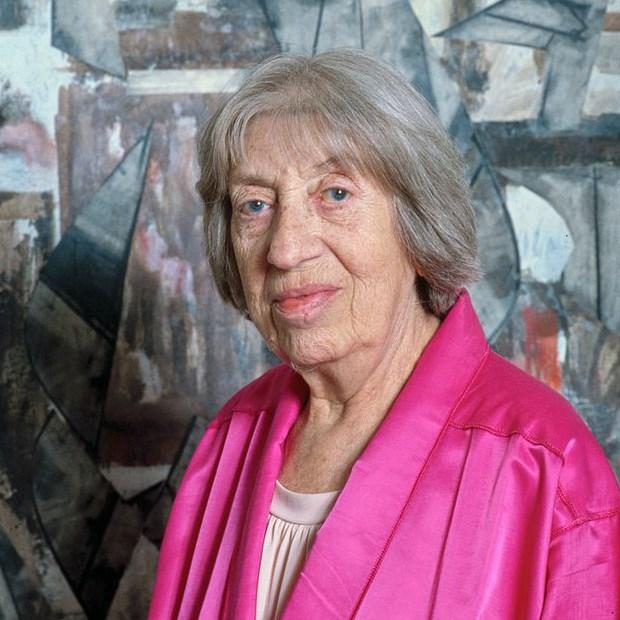
Lee Krasner (1908–1984, Brooklyn, New York, USA) was a major figure of American Abstract Expressionism whose restless experimentation produced a remarkably diverse body of work spanning more than five decades. Moving between vigorous abstraction, collage and large-scale painting, Krasner continually reinvented her visual language rather than settling into a single recognizable style.
Born to Russian-Jewish immigrant parents in Brooklyn, Krasner studied at the Cooper Union, the Art Students League and the National Academy of Design before joining Hans Hofmann's influential school in New York. During the 1930s and 1940s she became deeply involved in the emerging New York avant-garde and developed a sophisticated understanding of Cubism and European modernism that would become fundamental to her later work.
In 1945, Krasner married Jackson Pollock and the couple moved to Springs, East Hampton, where both produced some of their most important work. Although her career was long overshadowed by Pollock's extraordinary fame, Krasner maintained a fiercely independent artistic practice. Her celebrated Little Image paintings, radical collages made partly by cutting up earlier works, and later monumental canvases demonstrate her continuous willingness to destroy, reconstruct and transform her own imagery.
Following Pollock's death in 1956, Krasner entered an especially powerful period, taking over his larger studio and producing increasingly expansive paintings characterized by sweeping gestures, organic forms and intense colour. Recognition of her individual contribution to Abstract Expressionism grew significantly during the later decades of her life.
Today, Lee Krasner is regarded as one of the essential artists of Abstract Expressionism and a key figure in twentieth-century American art. Her work is held by major museums worldwide, and the major retrospective organized by the Museum of Modern Art in New York shortly after her death confirmed a reputation that has continued to grow substantially in the decades since.