

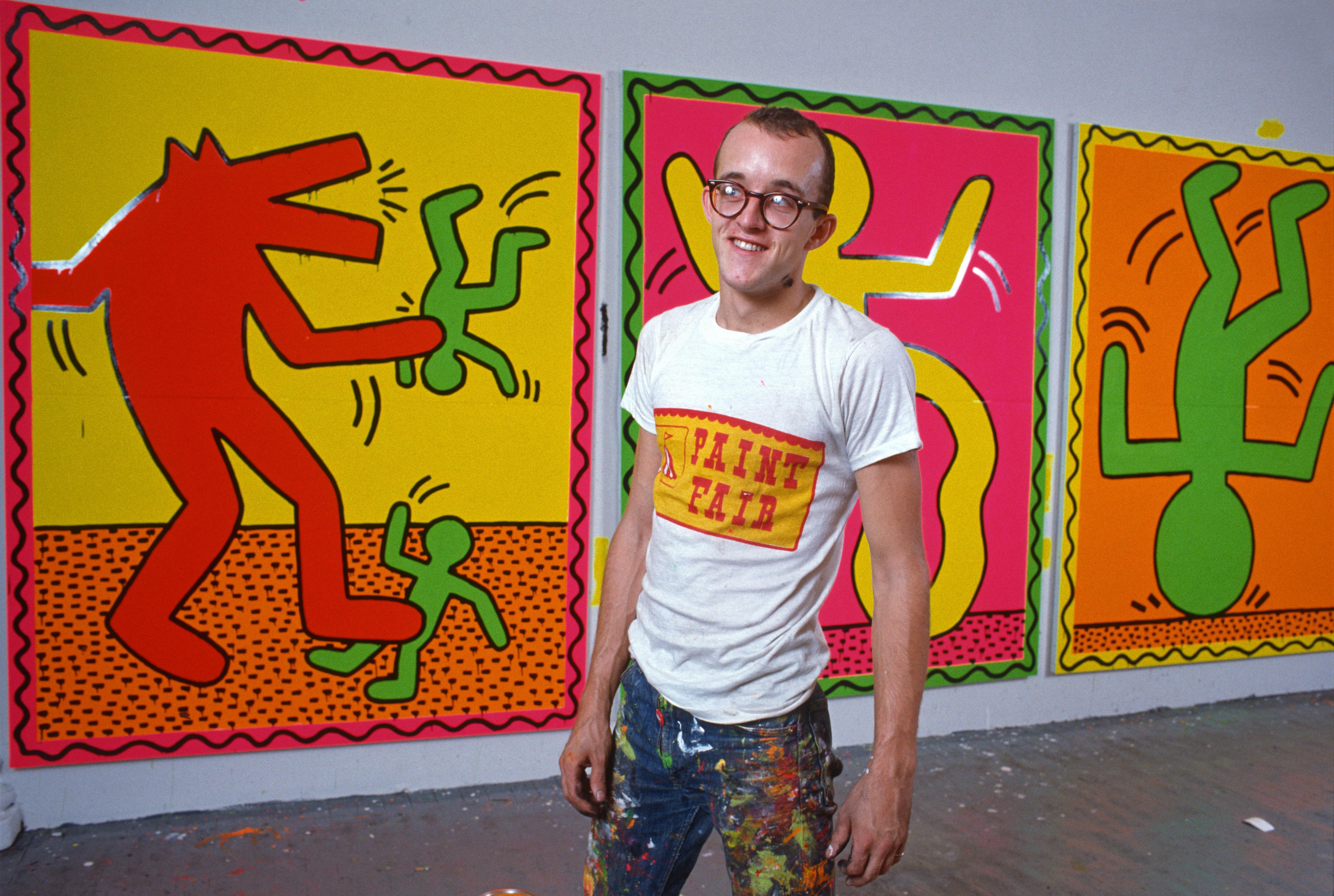
Keith HARING (1958–1990, Reading, Pennsylvania, USA) became one of the defining figures of late twentieth-century contemporary art, renowned for his bold graphic style, vibrant colours and instantly recognisable visual language. Inspired by New York's street culture, Haring transformed public spaces into accessible works of art while addressing social, political and humanitarian issues with remarkable energy and optimism.
After moving to New York in 1978 to study at the School of Visual Arts, Haring became closely associated with the city's emerging street art scene. His iconic chalk drawings in the subway quickly gained public attention, leading to exhibitions alongside artists such as Jean-Michel Basquiat and Andy Warhol. His simplified figures, radiant babies, barking dogs and dancing forms soon became universal symbols recognised around the world.
Throughout a career spanning little more than a decade, Haring created murals, paintings, sculptures and public art projects across the globe. Deeply committed to making art accessible to everyone, he frequently addressed themes including love, unity, social justice, anti-racism and the AIDS epidemic. Following his HIV diagnosis in 1988, he intensified his artistic and philanthropic activities, establishing the Keith Haring Foundation shortly before his death in 1990.
Today, Keith Haring's works are represented in major museum collections worldwide and continue to attract collectors for their cultural significance, visual immediacy and enduring influence on contemporary art, design and popular culture. His ability to bridge the worlds of street art, fine art and public engagement has secured his lasting place as one of the most recognisable artists of his generation.