

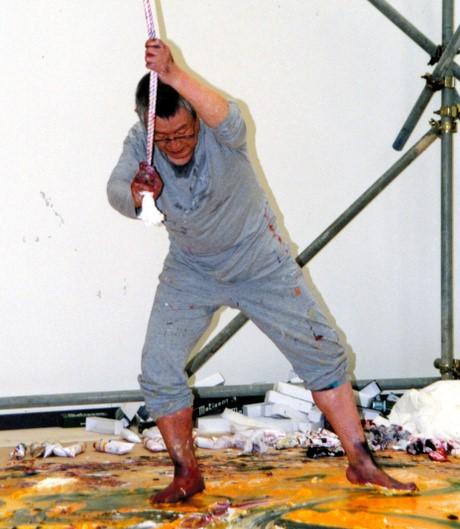
Kazuo Shiraga (1924–2008, Amagasaki, Japan) was one of the most radical figures of the Gutai Art Association and a pioneer of action-based painting in post-war Japan. Best known for creating paintings with his feet while suspended from a rope above the canvas, Shiraga transformed painting into a physical performance in which body, material and movement became inseparable.
Initially trained in traditional Japanese Nihonga painting at the Kyoto City Special School of Painting, Shiraga gradually rejected conventional techniques in search of a more direct and physical relationship with paint. In 1954 he began experimenting with foot painting, placing the support on the floor and using his entire body to push, drag and swirl thick oil paint across the surface.
Shiraga joined Gutai in 1955 and quickly became one of the group's defining figures. His performances and experimental works embodied Gutai's ambition to create something entirely new through direct confrontation with materials. Works such as Challenging Mud, in which he wrestled physically with a mass of wet clay, pushed this approach beyond painting and anticipated later developments in performance and body art.
From the late 1950s onward, Shiraga's paintings increasingly gained international attention through the support of French critic Michel Tapié, who connected Gutai with European Art Informel. Despite their explosive appearance, his mature foot paintings reveal a distinctive sense of rhythm and control, with dense layers of colour recording the movement of the artist's body across the canvas.
Today, Kazuo Shiraga is recognized as a central figure of Gutai and one of the most important Japanese artists of the post-war period. His radical fusion of painting and performance challenged traditional ideas of artistic authorship and helped establish a new understanding of the artwork as both a physical object and the trace of an action.