
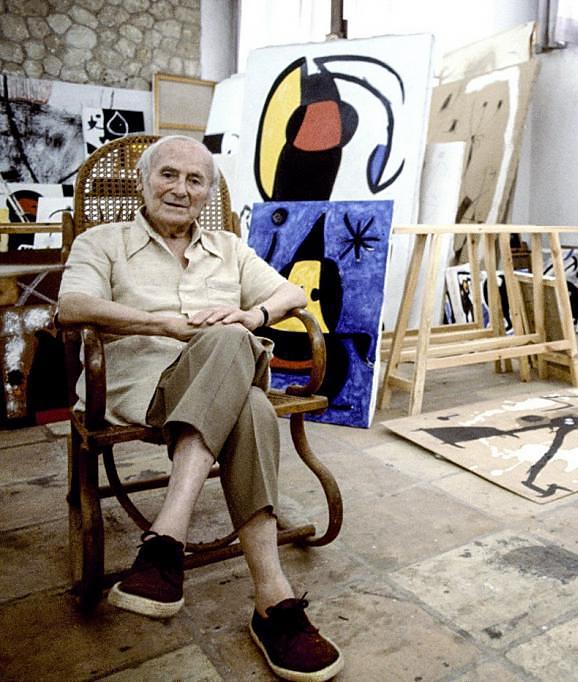
Joan Miró (1893–1983, Barcelona, Spain) painted stars while Europe descended into war.
At first glance, his art seems almost innocent: bright colours, wandering lines, birds, moons and mysterious little creatures. Yet behind this playful universe stood a man shaped by illness, political upheaval and a fierce desire for freedom.
Born in Barcelona, Miró was expected to pursue a conventional career. But in 1911, after suffering a serious illness and nervous breakdown, he spent months recovering in the Catalan countryside. Surrounded by nature at his family's farm in Mont-roig, he discovered a landscape that would inspire him throughout his life. He subsequently decided to devote himself entirely to painting.
When the Spanish Civil War broke out in 1936, Miró supported the Republic against Franco's forces. In 1937, he created The Reaper, a monumental image of a rebellious Catalan peasant, for the Spanish Republic's pavilion in Paris — the same pavilion where Picasso exhibited Guernica.
Then came the Second World War.
Living with his wife and daughter on the Normandy coast, Miró began his extraordinary Constellations series in 1940. When German troops advanced, the family fled back to Spain, where Franco was now in power.
Amid uncertainty and displacement, Miró continued painting. Between 1940 and 1941, he created 23 intimate compositions filled with stars, birds and imaginary creatures. While Europe was engulfed in conflict, he found refuge in a universe of extraordinary beauty and imagination.
But Miró was never simply a dreamer.
Even at the age of eighty, he was still challenging artistic conventions. In 1973, he deliberately cut and burned canvases, transforming destruction into a new form of creation.
His restless creativity also extended far beyond painting. Miró embraced lithography, etching, sculpture and ceramics, treating original printmaking as an artistic medium in its own right rather than merely reproducing his paintings.
He died in 1983, aged ninety, leaving behind an instantly recognisable visual language that continues to captivate generations of art lovers.
The next time you look at a Miró, look beyond the joyful colours. Those seemingly innocent stars and birds were created by a man who had experienced darkness — yet never surrendered his imagination.