
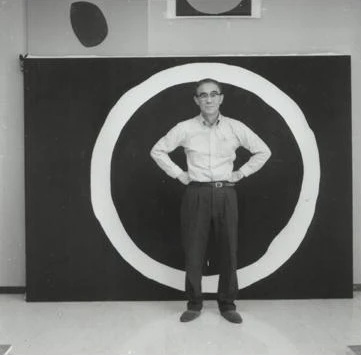
Jiro Yoshihara (1905–1972, Osaka, Japan) was a pioneering figure of post-war Japanese art and the founder and leader of the Gutai Art Association. Through both his own painting and his extraordinary influence on a younger generation of artists, Yoshihara helped establish one of the most radical avant-garde movements to emerge from Japan after the Second World War.
Initially active as a painter in Osaka, Yoshihara experimented with abstraction long before the formation of Gutai. In 1954, together with Shozo Shimamoto and a group of younger artists, he founded the Gutai Art Association. His guiding principle was uncompromising: artists should imitate neither tradition nor one another, but instead create something genuinely unprecedented. Under his leadership, Gutai embraced unconventional materials, outdoor exhibitions, performance, installation and direct physical engagement with paint and matter.
Yoshihara formulated the movement’s ideas in the influential Gutai Art Manifesto of 1956, arguing for a new relationship between human creativity and material itself. Rather than treating paint, mud, paper, water or other substances merely as tools, Gutai artists sought to reveal their inherent properties through action and experimentation. This philosophy encouraged artists such as Kazuo Shiraga, Atsuko Tanaka, Sadamasa Motonaga and Shozo Shimamoto to develop radically individual practices.
In his own later work, Yoshihara became particularly associated with the circle. From the late 1960s onward, he repeatedly painted large, imperfect rings in black or white, reducing his compositions to a single elemental gesture. These works combined apparent simplicity with an intense emphasis on execution, material and the physical trace of the artist’s hand.
Today, Jiro Yoshihara is recognized not only as an important abstract painter but as the intellectual and artistic force behind Gutai. His insistence on originality and experimentation helped position Japanese post-war art within an international avant-garde and continues to influence contemporary approaches to painting, performance and material-based art.