

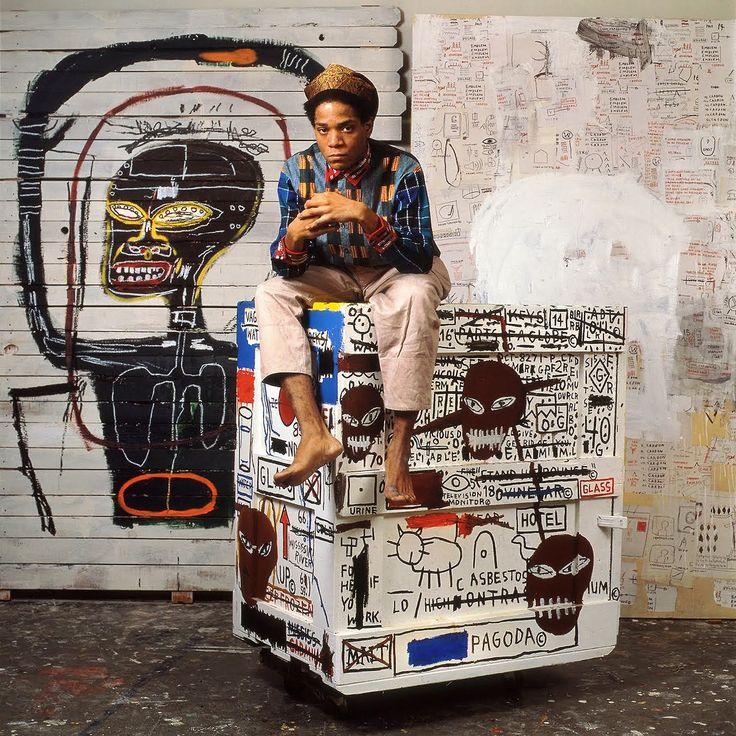
Jean-Michel Basquiat (1960–1988, Brooklyn, New York, USA) became one of the most extraordinary artists of his generation. His paintings burst with colour, words, skulls, crowns and seemingly chaotic figures. But behind that explosive visual language stood a remarkably intelligent, sensitive and ambitious young man whose life would end tragically before his twenty-eighth birthday.
His story began in Brooklyn.
Born to a Haitian father and a Puerto Rican mother, Basquiat grew up surrounded by different languages and cultures. His mother, Matilde, encouraged his artistic curiosity and regularly took him to museums.
When he was a child, Basquiat was seriously injured in a car accident. During his recovery, his mother gave him a copy of Gray's Anatomy, a medical textbook filled with anatomical illustrations. Its images of bones, muscles and internal organs would leave a lasting impression.
Years later, those childhood images would reappear in his paintings as mysterious skulls, exposed bodies and fragmented human figures.
As a teenager in the late 1970s, Basquiat began writing provocative messages on the streets of Manhattan with his friend Al Diaz. Their signature, SAMO, became a mysterious presence across the city.
But Basquiat wanted more than recognition on the streets.
By 1980, his work was appearing in exhibitions. Just two years later, at the age of 21, he was exhibiting at the prestigious Documenta in Germany, alongside some of the world's most established artists.
His rise was astonishing.
Yet beneath the excitement of success lay a much deeper artistic purpose.
Basquiat was acutely aware of racial inequality and the limited recognition given to Black figures throughout history. He drew inspiration from jazz musicians, boxers, athletes, African American culture and historical events.
His famous three-pointed crowns became powerful symbols of dignity, achievement and recognition. In his paintings, forgotten or overlooked figures could become kings.
And then came Andy Warhol.
In 1982, Basquiat was formally introduced to the legendary Pop Art artist. Shortly afterwards, he painted Dos Cabezas, a double portrait of himself and Warhol, reportedly completed within hours of their meeting.
An unlikely friendship developed between the young, fiercely expressive painter and the older, famously reserved artist.
They began collaborating on large canvases, combining Warhol's familiar commercial imagery with Basquiat's energetic lines, figures and handwritten words. Their work brought two generations of New York art into direct conversation.
But fame came at a price.
Basquiat faced intense public scrutiny, racial stereotyping and growing pressure from an art market fascinated by his extraordinary success. His struggles with heroin addiction increasingly overshadowed his personal life.
When Warhol died unexpectedly in February 1987, Basquiat lost a close friend and artistic companion.
Just eighteen months later, on 12 August 1988, Basquiat died from a heroin overdose in his New York studio. He was only 27 years old.
His artistic career had lasted barely a decade.
Yet in that remarkably short time, he created an unmistakable visual language that challenged conventional ideas about beauty, identity, power and artistic expression.
Basquiat's paintings may appear chaotic, but their disorder is filled with meaning. Behind every crown, skull and crossed-out word lies an artist determined to make himself heard — and to give a voice to people and histories too often overlooked. His life was tragically brief, but his artistic voice remains impossible to silence.