

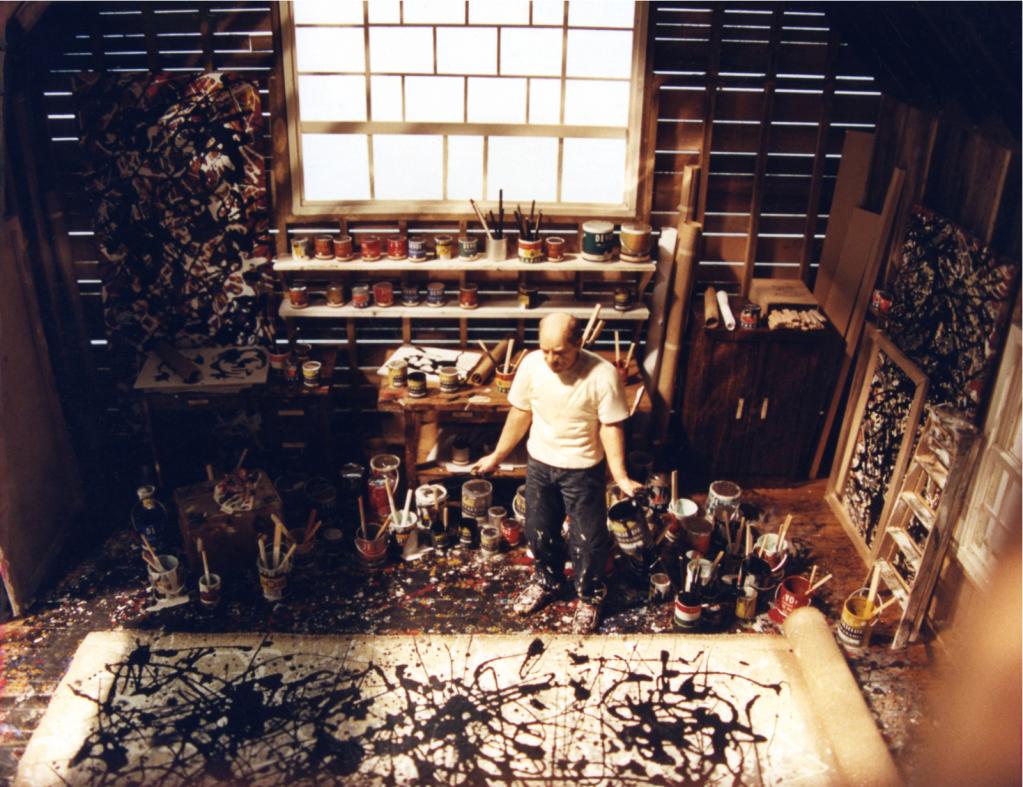
Jackson Pollock (1912–1956, Cody, Wyoming, USA) transformed post-war American painting through a radical approach in which gesture, movement and the physical act of creation became inseparable from the finished work. As a central figure of Abstract Expressionism, his revolutionary drip paintings helped shift the centre of the international avant-garde from Europe to New York.
Pollock moved to New York in 1930 and studied with the Regionalist painter Thomas Hart Benton at the Art Students League. His early work absorbed influences ranging from Mexican muralists and Native American art to Picasso and Surrealism. During the 1940s, these diverse sources gradually gave way to an increasingly abstract and personal visual language.
His breakthrough came in the late 1940s when he began placing large canvases directly on the floor of his studio in Springs, East Hampton. Rather than using a conventional easel, Pollock poured, dripped and flung liquid paint using sticks, hardened brushes and other implements while moving around the canvas. The resulting compositions abandoned traditional focal points in favour of intricate webs of line extending across the entire surface, a method that became known as action painting.
Works such as Autumn Rhythm (Number 30), One: Number 31, 1950 and Blue Poles demonstrate the extraordinary balance between spontaneity and control within his mature work. Although their appearance can seem chaotic, Pollock carefully controlled the rhythm, density and movement of the paint, creating compositions that record both physical gesture and sustained concentration.
Pollock's career was intense but brief. He died in a car accident in 1956 at the age of 44, leaving behind a body of work that fundamentally altered the possibilities of painting. Today, Jackson Pollock is regarded as one of the defining artists of post-war American art, and his radical transformation of the canvas into an arena for artistic action continues to influence contemporary painting and performance.