
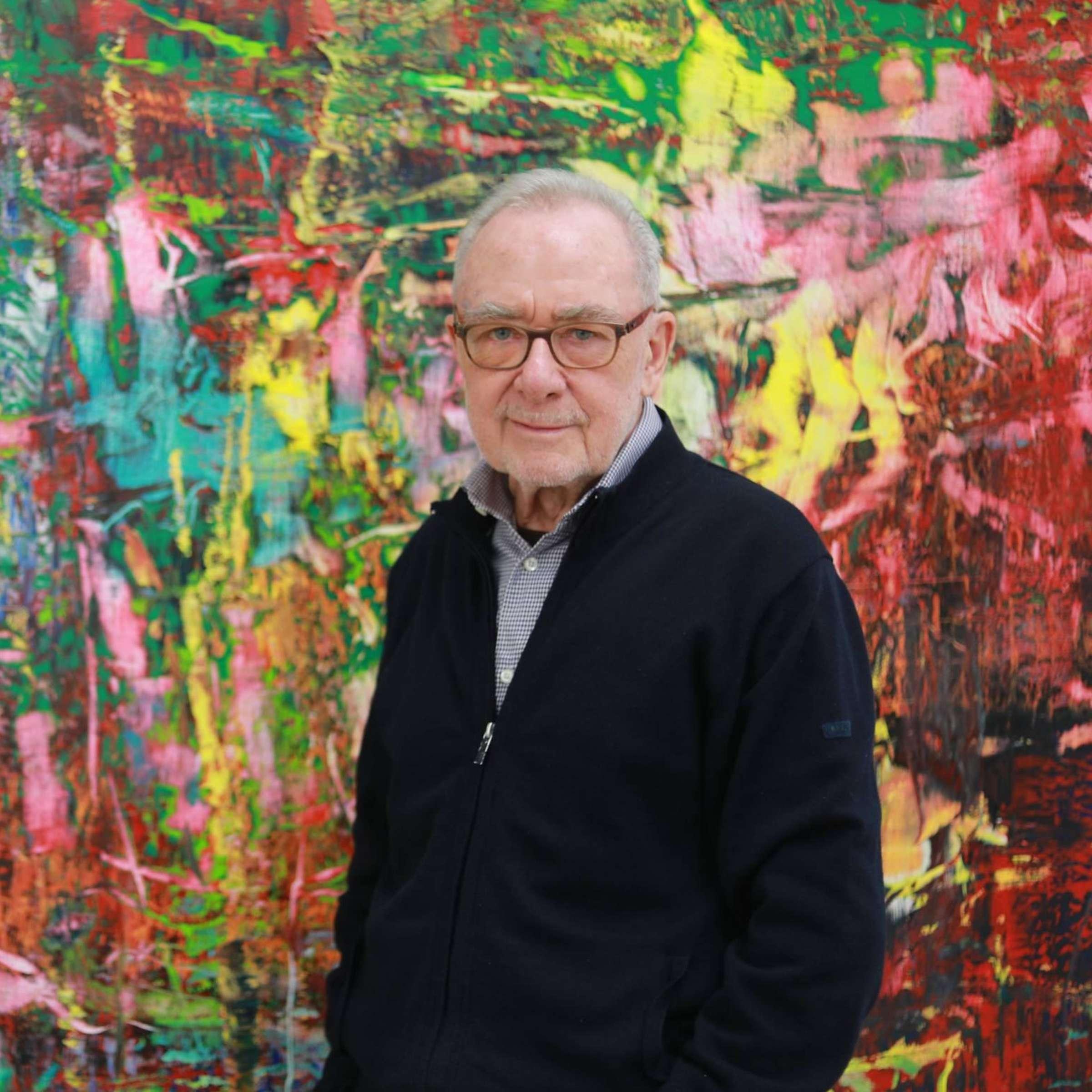
Gerhard Richter (°1932, Dresden, Germany) is one of the most influential artists of the post-war era, renowned for a remarkably diverse practice that continually questions the relationship between painting, photography, abstraction and reality. Moving between blurred photo-based paintings, portraits, landscapes, monochromes and vast abstract compositions, Richter has consistently resisted the idea that an artist should be defined by a single recognizable style.
Raised in eastern Germany, Richter studied at the Dresden Academy of Fine Arts before leaving East Germany for the West in 1961, shortly before the construction of the Berlin Wall. He subsequently studied at the Kunstakademie Düsseldorf, where he encountered the emerging international avant-garde and artists including Sigmar Polke and Konrad Lueg. Together they developed an ironic response to both Socialist Realism and Western consumer culture that they called Capitalist Realism.
During the 1960s, Richter began translating photographs from newspapers, family albums and other sources into paintings. By dragging a brush across the still-wet surface, he created the characteristic blur that became a defining feature of works such as his family portraits, cityscapes and the later October 18, 1977 cycle. Rather than simply reproducing photographs, these paintings explore memory, history and the uncertain relationship between an image and the reality it appears to document.
Alongside his figurative work, Richter developed an equally important abstract practice. From the 1980s onward, he increasingly applied and removed layers of paint using large squeegees, allowing chance and deliberate intervention to interact across the canvas. The resulting Abstraktes Bilder combine sweeping fields of colour, scraped surfaces and unexpected underlying layers, making the physical process of painting visible within the finished work.
Richter has also created major installations and public commissions, including the monumental stained-glass window for Cologne Cathedral. His works are represented in leading museum collections worldwide, and major retrospectives have been devoted to his career at institutions including the Museum of Modern Art in New York, Tate Modern in London and the Neue Nationalgalerie in Berlin.
Today, Gerhard Richter remains a defining figure of contemporary painting. His sustained investigation of what images can reveal—or conceal—has produced an extraordinarily varied body of work and made him a crucial link between the history of post-war painting and the continuing possibilities of the medium.