

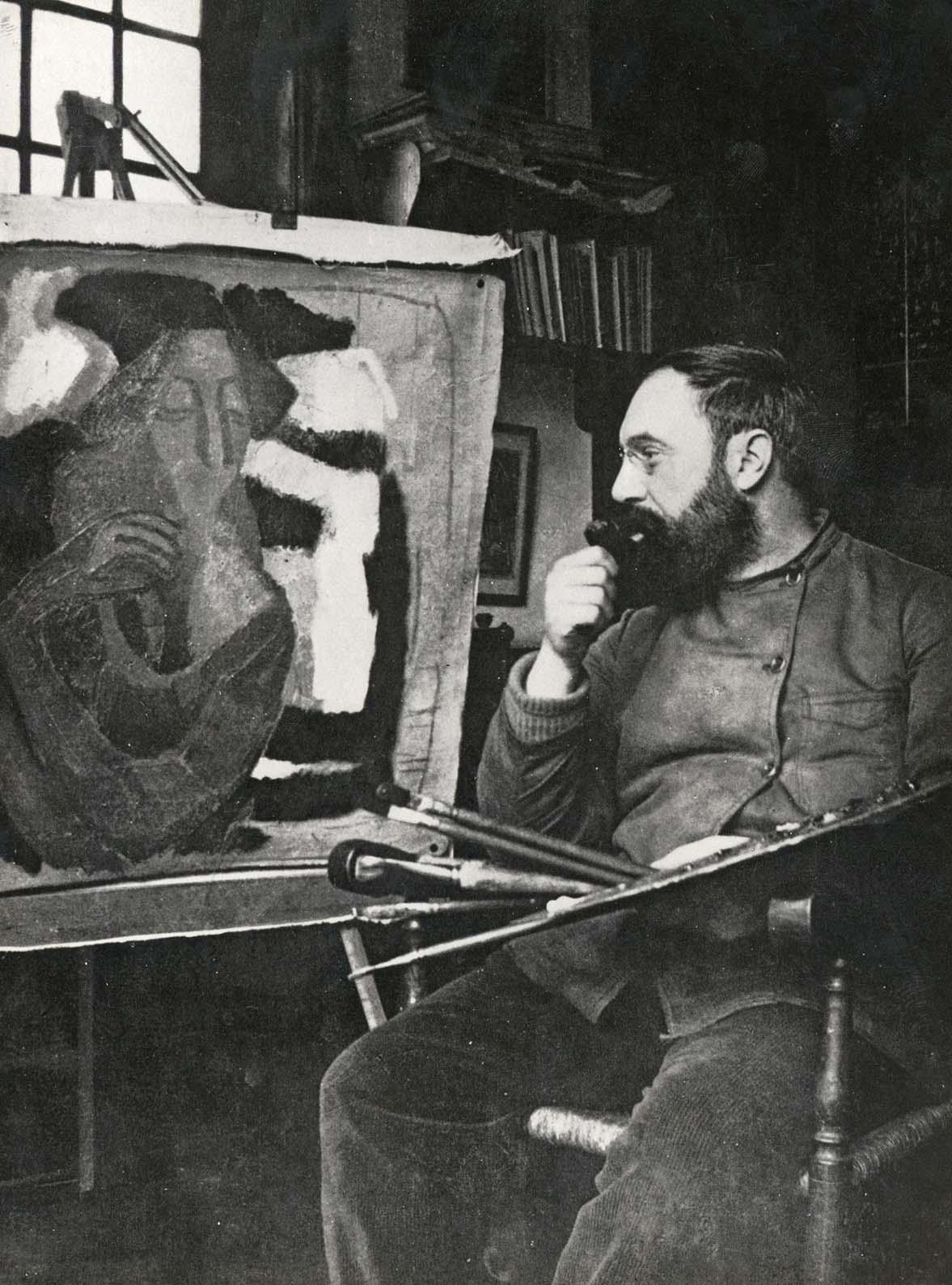
Frits Van den Berghe (1883–1939, Ghent, Belgium) was a major figure of Belgian Expressionism whose work evolved from intimate scenes of rural life toward increasingly imaginative and psychologically charged compositions. Closely associated with the artists of Sint-Martens-Latem, he developed a distinctive visual language in which distorted figures, dreamlike imagery and dark humour gradually became central.
Van den Berghe studied at the Royal Academy of Fine Arts in Ghent and initially worked in a more traditional, impressionistic manner. His contact with artists such as Constant Permeke and Gustave De Smet proved decisive, and during the First World War his work moved toward a more expressive treatment of form and colour. After the war, he became one of the leading representatives of Flemish Expressionism.
During the 1920s, Van den Berghe's painting became increasingly experimental. Human figures were simplified and distorted, while interiors, landscapes and everyday scenes took on a strange, often unsettling atmosphere. His growing interest in psychology, dreams and the irrational brought his work close to Surrealism, although he remained stylistically independent and never fully belonged to the movement.
From the late 1920s onward, economic difficulties led him to work increasingly as an illustrator and caricaturist for newspapers and magazines, particularly the Ghent newspaper Vooruit. In his final years his health deteriorated significantly, while his work became increasingly introspective and fantastical. He continued drawing and illustrating until shortly before his death in Ghent in 1939.
Today, Frits Van den Berghe is regarded as one of the most important Belgian modernists of the interwar period. His transformation from Flemish Expressionism toward a darker, more introspective and fantastical visual world gives his oeuvre a unique place within twentieth-century Belgian art.