

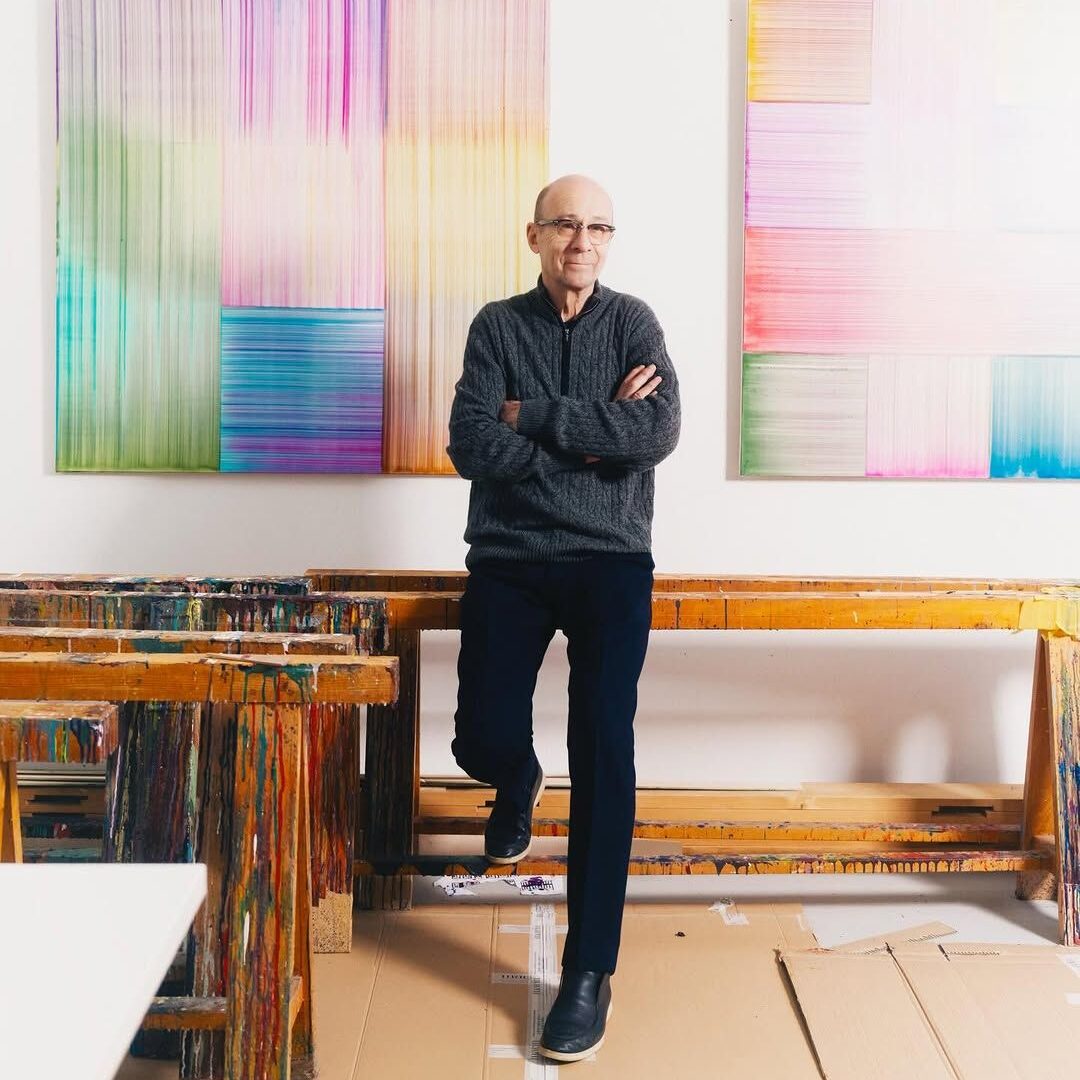
Bernard Frize (°1949, Saint-Mandé, France) is a French painter whose work challenges traditional ideas of artistic expression, authorship and composition. Rather than approaching painting as a vehicle for personal gesture, Frize develops systems, rules and procedures that determine how each work is made. The resulting paintings combine rigorous conceptual structures with an often unexpectedly sensuous and colourful appearance.
Since the late 1970s, Frize has explored the possibilities of paint through deliberately simple processes. He may use several brushes simultaneously, allow different colours to mix directly on the canvas, repeat a predetermined movement, or organise the work around the physical properties of the paint itself. Once a method has been established, he follows it with minimal intervention, allowing chance, gravity, viscosity and the interaction between colours to become active elements in the finished composition.
This approach produces paintings characterised by flowing bands of colour, interwoven brushstrokes, grids and luminous surfaces. Although they can appear spontaneous and expressive, their visual complexity often results from highly controlled procedures. This tension between system and accident, control and unpredictability is central to Frize's practice and gives his work its distinctive character.
Frize emerged internationally during the 1980s and has since become an important figure in contemporary European painting. His work has been exhibited extensively in museums and institutions worldwide, including a major retrospective at the Centre Pompidou in Paris in 2019. His paintings are represented in numerous public collections, among them the Centre Pompidou, Tate, the Museum of Contemporary Art in Los Angeles and the Kunstmuseum Basel.
By deliberately removing personal expression from the act of painting, Frize has developed a practice in which the process itself becomes the subject. The apparent simplicity of his methods often produces remarkably complex results, making his work immediately recognisable while allowing each painting to remain the record of a unique experiment.