

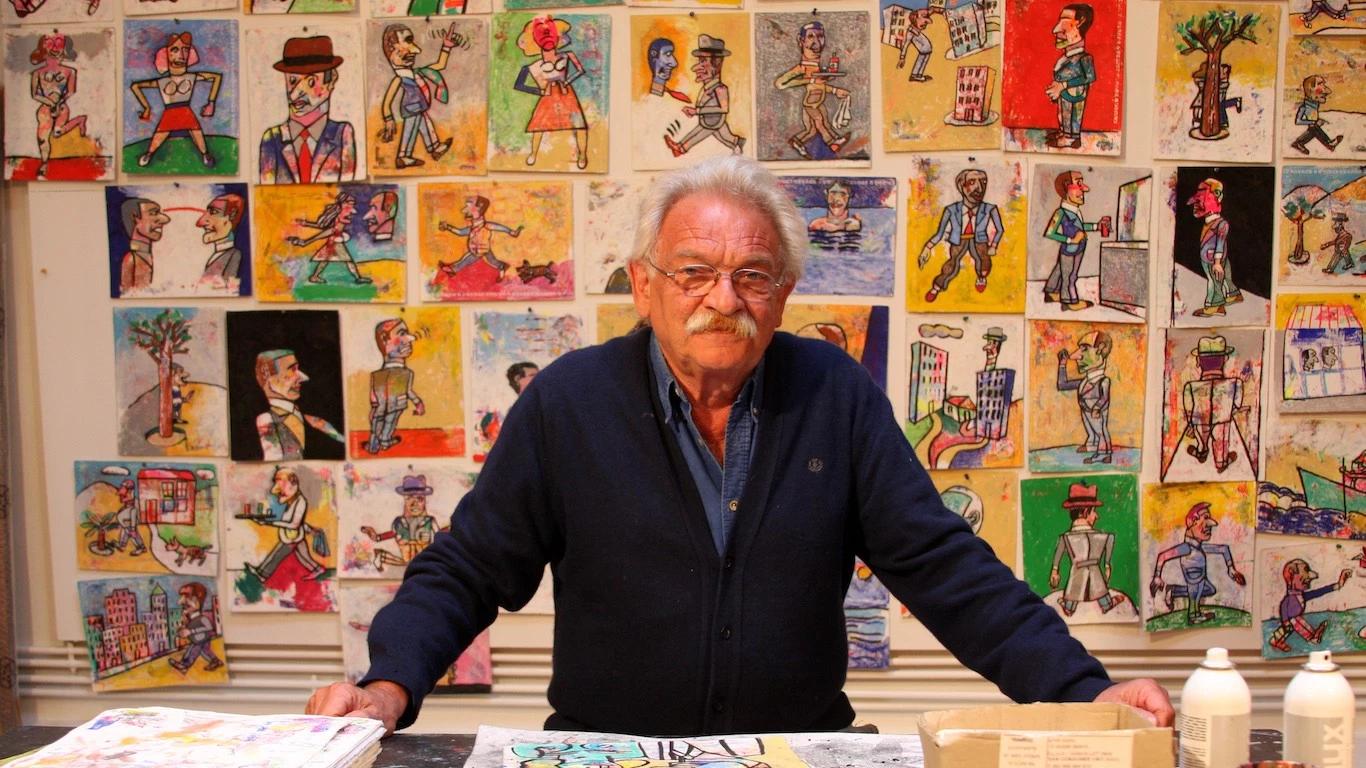
Antonio Seguí (1934–2022, Córdoba, Argentina) was a major figure of Latin American figurative art, known for his distinctive urban scenes populated by anonymous, often bowler-hatted figures moving through crowded cities. Combining humour, social observation and a deliberately simplified graphic language, Seguí created an immediately recognizable world in which the absurdities of modern life are played out like an endless human theatre.
After studying art in Córdoba, Seguí travelled extensively through Europe and Africa during the early 1950s and attended courses at the Real Academia de Bellas Artes de San Fernando in Madrid and the École des Beaux-Arts in Paris. He later travelled throughout Latin America and studied printmaking in Mexico before settling permanently near Paris in 1963, where he would live and work for most of his career.
From the 1960s onward, the human figure became central to Seguí's work. His paintings, drawings and prints frequently depict dense urban environments filled with small characters walking, gesturing and interacting, creating compositions that are simultaneously playful and subtly critical. Influences ranging from Fernand Léger and Diego Rivera to comics, caricature and popular imagery helped shape a visual language that allowed him to explore individuality, conformity, isolation and the rhythms of city life.
Seguí worked across painting, drawing, printmaking, sculpture and book illustration and exhibited extensively throughout Europe, Latin America and the United States. His work entered major public collections including the Centre Pompidou and the Museum of Modern Art in New York, reflecting the international recognition he achieved over a career spanning more than six decades.
Today, Antonio Seguí is remembered as one of Argentina's most internationally recognized artists. His unmistakable crowds of humorous, restless figures continue to offer a witty yet perceptive reflection on modern society and the individual's place within the contemporary city.