

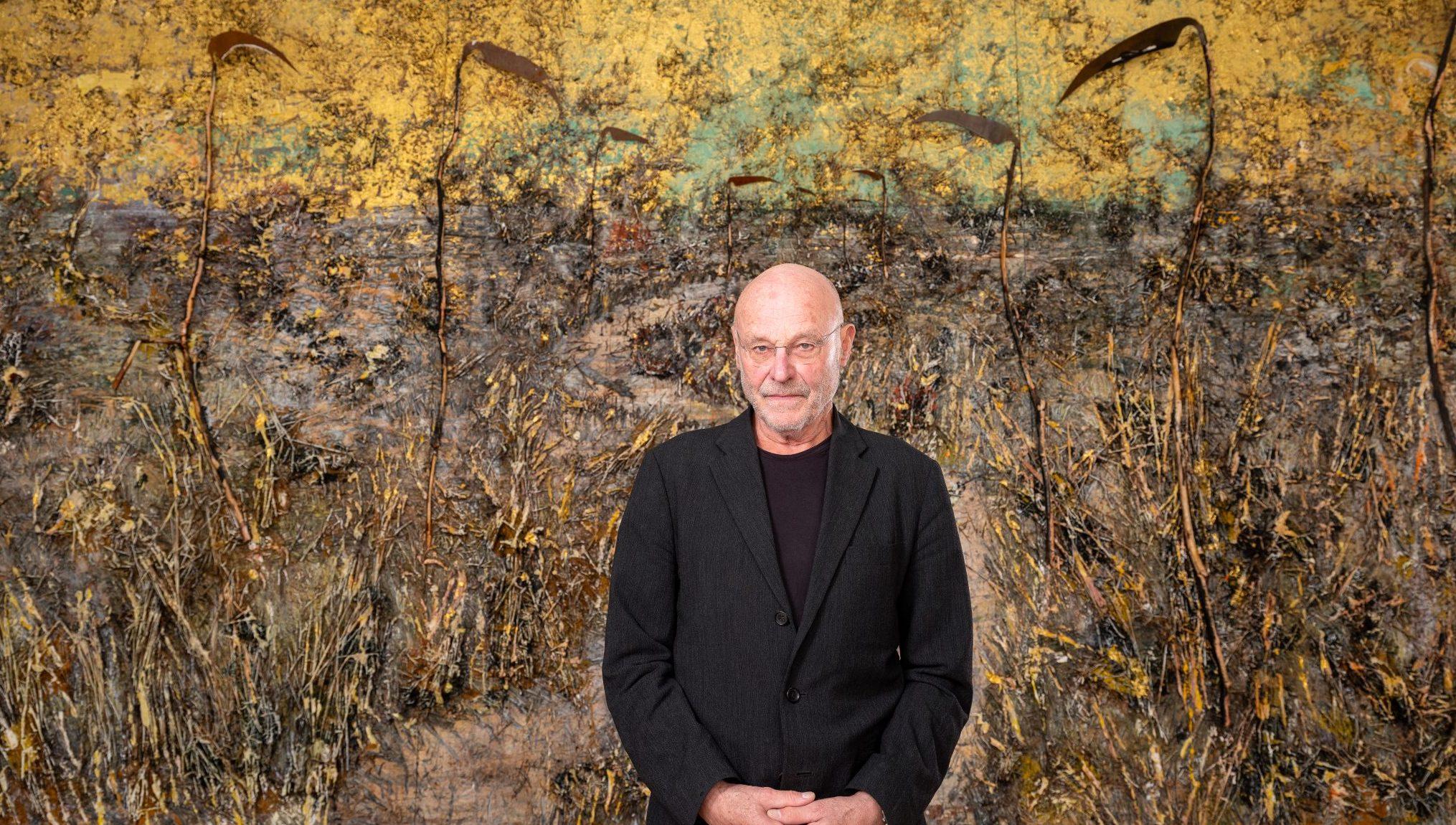
Anselm Kiefer (°1945, Donaueschingen, Germany) is a central figure in post-war German art, known for monumental works that confront history, memory, destruction and renewal. Working with materials such as lead, ash, straw, clay, concrete and charred wood, Kiefer creates densely layered paintings and sculptures whose physical surfaces carry as much meaning as their imagery.
Growing up in Germany in the immediate aftermath of the Second World War profoundly shaped his artistic development. After studying under Peter Dreher and Horst Antes, Kiefer became associated with Joseph Beuys at the Kunstakademie Düsseldorf. From the beginning of his career, he addressed subjects that many German artists of his generation were reluctant to confront, particularly the legacy of National Socialism and the ways in which history is remembered, suppressed and reconstructed.
Over time, Kiefer's practice expanded far beyond German history to encompass mythology, literature, poetry, alchemy, astronomy, religion and philosophy. References to figures such as Paul Celan, Ingeborg Bachmann and ancient mythologies recur throughout his work. His vast landscapes, ruined architectures, books and towers often suggest civilizations caught between collapse and regeneration.
Kiefer has represented Germany at the Venice Biennale and has been the subject of major exhibitions and retrospectives at institutions including the Royal Academy of Arts in London, Centre Pompidou in Paris and the Grand Palais. His monumental studio complex at Barjac in southern France, known as La Ribaute, has itself developed into an extraordinary environment of sculptures, towers, tunnels and installations.
Today, Anselm Kiefer continues to work on an exceptional scale, moving freely between painting, sculpture, architecture and installation. His uncompromising engagement with history and the material transformation of memory has established him as one of the defining artists of the post-war era.