
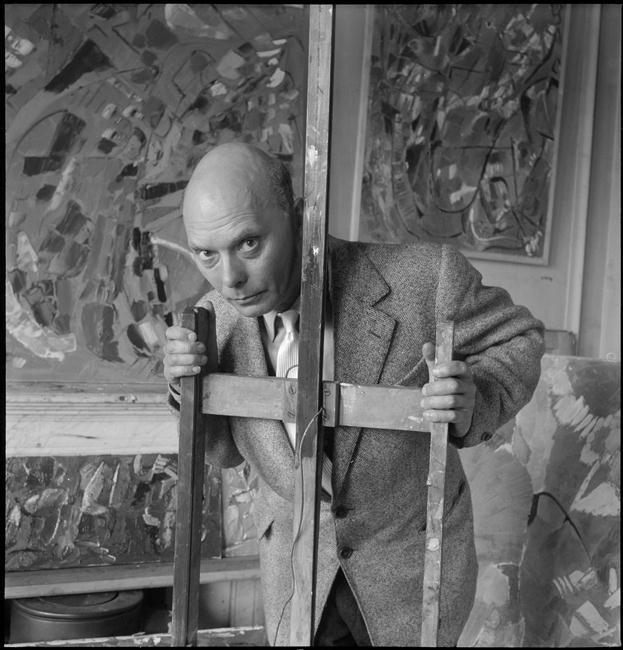
André Lanskoy (1902–1976, Moscow, Russia) developed a richly coloured and highly personal form of abstraction, characterized by interlocking shapes, rhythmic compositions and an intense, luminous palette. Emerging from the vibrant artistic environment of post-war Paris, he became closely associated with the École de Paris and established himself as an important representative of lyrical abstraction.
Born Andrei Mikhailovich Lanskoy in Moscow, he left Russia following the Revolution and eventually settled in Paris in 1921. Initially working figuratively, Lanskoy quickly attracted attention and exhibited at the Salon d'Automne, where his paintings were noticed by the influential German collector Wilhelm Uhde. During the 1920s and 1930s, his work entered important collections and he developed relationships with artists including Robert and Sonia Delaunay.
During the 1940s, Lanskoy progressively abandoned recognizable imagery in favour of abstraction. His mature paintings are constructed from dense networks of irregular coloured forms that appear to shift, overlap and interact across the surface. Colour became the principal driving force of his compositions, creating a sense of movement and visual rhythm that remained central to his work throughout the following decades.
Lanskoy maintained a particularly important artistic friendship with Nicolas de Staël, with whom he shared an interest in the expressive possibilities of colour and abstract form. Alongside painting, he experimented extensively with collage, gouache, tapestry and works on paper, continually exploring new ways of organizing colour within the pictorial space.
Today, André Lanskoy is recognized as a distinctive voice within post-war European abstraction. His works are held in major museum collections including the Centre Pompidou in Paris and continue to attract collectors for their energetic compositions, sophisticated colour relationships and immediately recognizable visual language.