

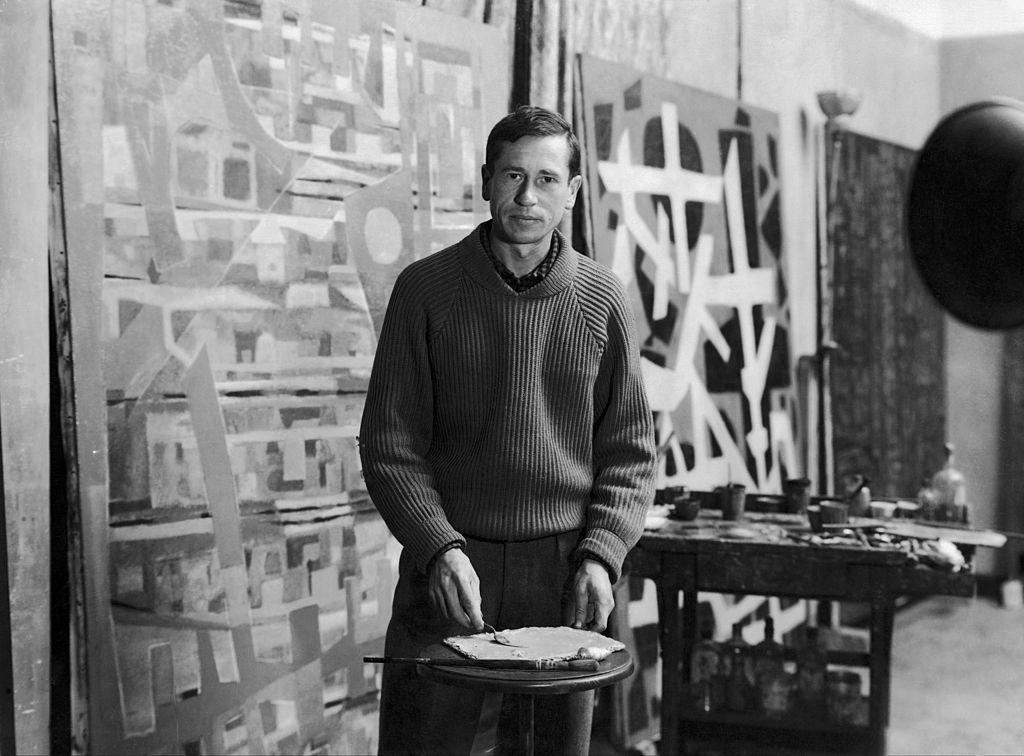
Alfred Manessier (1911–1993, Saint-Ouen, France) was a leading figure of post-war French abstraction, celebrated for luminous compositions in which colour, light and rhythm evoke both the natural world and profound spiritual experience. His richly structured paintings, often resembling fragments of stained glass, occupy a distinctive position between lyrical abstraction and non-figurative sacred art.
Manessier studied architecture at the École des Beaux-Arts in Paris while increasingly devoting himself to painting. During the 1930s his work remained largely figurative, but encounters with modern artists and the upheavals of the Second World War gradually led him towards abstraction. A retreat at the Trappist monastery of La Trappe in 1943 proved particularly significant, deepening the spiritual dimension that would remain central to much of his later work.
After the war, Manessier emerged as an important representative of the new French non-figurative painting. Rather than abandoning reality entirely, he transformed impressions of landscapes, changing seasons, water and light into networks of coloured forms. His fascination with luminosity also led naturally to stained glass, and he produced important windows for numerous churches alongside tapestries, mosaics and other monumental works.
Although Christian spirituality played an important role in his art, Manessier also responded strongly to contemporary political and humanitarian events. His later paintings addressed subjects including war, injustice and struggles for freedom, demonstrating how abstraction could carry emotional and ethical meaning without relying on conventional narrative imagery.
Today, Alfred Manessier is recognized as an important voice within the École de Paris and post-war European abstraction. His distinctive synthesis of colour, light, landscape and spirituality gave his work a contemplative intensity that remains immediately recognizable within twentieth-century French painting.